One + One (+ Who You Choose) = A Family

Happy Mother’s Day!

When you think of the word family, the image that Hollywood has created for us is Mom, Dad and 2(ish) kids.  Mom and Dad love each other, never fight, never have financial difficulty and perfectly parent their adorable children, who are well mannered, speak politely to their parents, always keep their rooms clean and maintain straight A averages in school.  For some (I dare say, a very small percentage), that may be reality.  I think most people (not all, I’m well aware), at some point in their lives, hope for such a scenario.  Let me back up – I believe that is probably true for most of the people of my generation, who were brought up by parents who themselves were parented in the 50s and 60s, and perhaps did live in such an idyllic setting.  At least that was true of my parents.

My definition of what makes a family has changed drastically over the last 14 years.  When JJ and I were first married, we discussed having children.  He wanted them and I wasn’t 100% sold on the idea.  After being married for a few years, my perspective on having children changed to where I wanted them too.  I started to feel like having a child or children that were part of him and part of me (hopefully the best parts of both) to carry on our legacy would be some combination of good, great, acceptable, expected, dutiful, fun.  To be honest, my sentiments on the subject varied, depending on the day.

In Feb 2007 (three months shy of our third anniversary), I came off the pill.  We expected it would take possibly a few months for my body to readjust and didn’t expect to get pregnant right away.  I wasn’t concerned for the first 6 months since I was by then 31 and knew it probably wouldn’t happen as quickly as it might have if I was still in my 20s. By the end of the first year of “not preventing,” we started “trying.”  I started counting days, taking my temperature, and using an ovulation kit.  We also looked into some alternative methods.  I had a friend who had also struggled with infertility, went to an acupuncturist and was able to conceive.  So, we gave it a shot, with no results.  We tried different essential oils to promote fertility and balance out my hormones without any success.  By the end of year two, we “stopped trying” since the advice we were getting at that point was to “stop worrying about it” and “you’re trying too hard to make it happen.”  At some point in year 3 we turned towards a more western medicine approach.  We were told that there were issues on both sides of the equation.  I went through one round of oral fertility meds and decided that was not for me (I felt like I was high, but in slow motion all at the same time).  JJ was given a surgical recommendation that would give us a 50/50 chance of getting pregnant.  My thinking was that we already had a 50/50 chance, so we opted to not have surgery.

Years 2-5 were emotionally exhausting to ride the roller coaster every 25-30 days.  We had other factors that added to the emotional strain – most of our friends were growing their families over those same years, and while I was always happy and excited for them, it always stung a bit too when people announced that they were pregnant (for the first time, or again) or when I was invited to a baby shower.  Somewhere in year 4 or 5, we received an offer from a lady in the local area who was pregnant to adopt her baby.  We took some time to pray and consider this option (since neither of us felt called to pursue adoption via the traditional route) and felt that perhaps this was how God meant for us to have a family.  In the few days that we took to come to the decision to adopt her child, the mom-to-be had some tests run, was told that the baby had Downs and decided to terminate the pregnancy.  I have been asked many times if we would have adopted a baby with Downs.  My honest answer is I still don’t know.  We were never faced with having to make that decision.

We went through all the public, polite conversations about having children.  “How long have you been married?  Oh, and no children yet?  But you’re planning to have children, right?”  For several years, the default answer became “not yet” and that, along with a smile, would quiet the conversation.  After about 5 years, we changed our tune to just “no” and then that prompted a whole series of “why not? Have you tried fertility treatments?  Have you thought about in vitro?  Have you considered adoption?  We’ll be praying for you.”  While the questions and comments were well meaning, it never ceased to amaze me how people we might have just met (because all of our friends knew the story and had stopped asking questions by that time) feel entitled to ask ridiculously personal questions that were none of their business.  It no longer surprises me.  On more than one occasion, I would get stuck answering the same series of questions and explaining myself/justifying why we had or not had done or considered whatever option(s) that particular person felt inclined to ask about. I would feel embarrassed about our choices and found myself drowning in second guesses.  If JJ was with me, but not immediately involved in the conversation, on multiple occasions he would have to come over and bail me out to shut down the conversation or change the topic.

Through years 5-7, I really struggled with whether or not I was holding up my end of the bargain as a wife, even though we both had fertility issues.  I think the fact that there were issues on both sides of the equation made it easier for both of us – it wasn’t something that either of us could hold against the other (I don’t believe this is something we would have done anyway, but the possibility certainly could have existed).  I struggled for a long time with feeling like I wasn’t complete, that our marriage wasn’t whole, that I had failed/we had failed.  I had difficulty reading Psalm 127: 3-5 “Children are a heritage from the Lord, offspring a reward from him.  Like arrows in the hands of a warrior are children born in one’s youth.  Blessed is the main whose quiver is full of them.” (NIV).

It took me another 2-3 years to come to see that marriage is not JUST about having children and that leaving a legacy does not ONLY involve DNA.  God can use your life to impact people with whom you do not share blood just as powerfully as He can with those that you do.  The surrounding verses in Isaiah in my post a few weeks ago speak to this very topic: “Sing, barren woman, you who never bore a child; burst into song, shout for joy, you who were never in labor, because more are the children of the desolate woman than of her who has a husband,” says the Lord. “Enlarge the place of your tent, stretch your tent curtains wide, do not hold back; lengthen your cords, enlarge your stakes.  For you will spread out to the right and to the left; your descendants will dispossess nations and settle in their desolate cities.  Do not be afraid; you will not be put to shame. Do not fear disgrace; you will not be humiliated.” (Isaiah 54: 1-4.  NIV).  Granted, I have a husband, but I know that we are creating a legacy that goes far beyond the four walls of our house.

We lead a small group through our church for young married couples, who we all consider part of our family.  Now, when our friends tell us that they are pregnant, there is fullness of joy for them without any sting.  Going to baby showers or to visit friends in the hospital after they have had a baby are fun and rewarding experiences.  That doesn’t mean that I still don’t get a twinge every now and then (I am still human!), but they are fewer and farther between.  I created a church “family tree” of sorts (with much help from some dear friends who we also count as part of our family)– it is a painting of a tree that hangs over our dining room table and on it all the members of our small group have written their names.  When I have a moment where I feel sad or sorry for myself, I have something to look at and remind me of the goodness of God in our lives, how JJ and I together are a family and how many amazing and diverse family members He has added to our family.
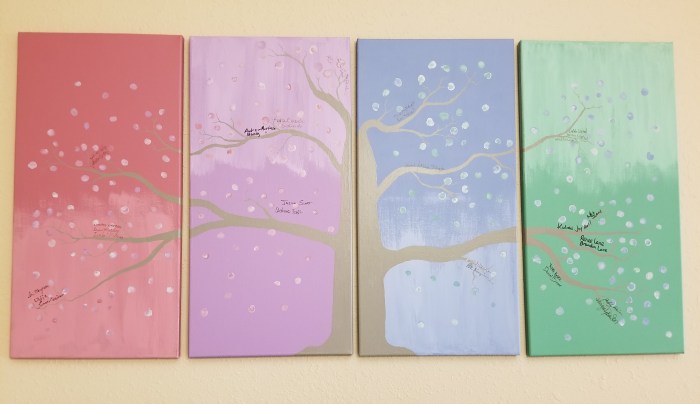
Family Tree

We were presented a second time with an opportunity to adopt a child in the early part of fall last year.  The child was a 5 year old little boy from Texas.  We decided in an evening (given our history the last time) to look into the details and my mind started swimming with the idea of having a child in the house by Thanksgiving – buying school clothes and school registration, redoing the guest room into a child’s room, how much and how drastically our lives would change in a few weeks to a few months.  The following day when I spoke to his case worker, I was informed that he was already in foster care and his foster parents planned to adopt him and his half-sister (information we had not previously received).  Having been partially through the process of adoption now twice, I admit that we are gun shy to consider it again, but I have learned to never say never.

Mother’s Day has typically been a challenging day for me – people at church smile and wish me happy Mother’s Day and I have politely smiled back.  This year, honestly for the first time, I’m focusing on all the people who are such a blessing in our life, who we count among our extended family. To all the moms, moms to be, and “moms” of your chosen family, Happy Mother’s Day!
Simple, But Not Easy

I’ve discovered, as I’m sure many of you have too, one of the main themes of life is that oftentimes the things we wish to accomplish or the challenges we want to overcome require a course of action that is simple, but not easy.  This concept is all encompassing and not limited to any specific area of life.

For instance, if you want to get or complete your education, the degree plan that your advisor lays out may seem very simple, but studying for and passing some of the required classes may not be easy.  If you want to lose weight, knowing which foods to eat and which ones to avoid, when to eat and how much water to drink seems like a simple plan, but adhering to that plan is not easy. For me this is especially true if there is chocolate (the darker the better) or ice cream (I was born with the ice cream gene – this gene has been passed down on my mother’s side, starting with my grandfather) immediately accessible.  If you want to start saving for retirement, setting aside a certain percentage of your income is a simple math calculation, but figuring out how to adjust the rest of your budget with that percentage removed can be difficult for the first several months.

So what happens when you knowingly and consciously make choices that are counter to your desired end goal?  Why is it so easy to justify falling off the wagon and give into the little voice that says “Go ahead, spend that extra $20” or “That piece of cake won’t hurt anything”?  Here’s some good news – this is a centuries old problem.  In his letter to the Romans, Paul writes “I do not understand what I do. For what I want to do I do not do, but what I hate I do. For I do not do the good I want to do, but the evil I do not want to do—this I keep on doing. ” (Romans 7:15, 19, NIV).  Matthew 26:41 reiterates this thought: “Watch and pray so that you will not fall into temptation. The spirit is willing, but the flesh is weak.” (NIV).  I have had many times when I made my mind up to do something or not do something and have then turned around (sometimes immediately, I might add) and done something completely opposite of what I had initially determined to do.  For the most part, I am now at the point where when I have set a goal and I take an action that is not going to move me towards accomplishing that goal, I can admit to myself that I am making that conscious choice, so the only one responsible for a slower timeline is me.

Keeping your goal in the forefront of your mind is key and I have found it helps to set up some kind of reminder.  The reminder you choose might be a magazine picture on your fridge of a place you are saving to go on vacation, or an item of clothing that you want to be able to get into (or back into) that you hang in a highly visible place in your bathroom or your closet, or it might be something as simple as a date on your calendar.  Setting benchmarks on the way to your end goal also helps maintain motivation so you can see where you started, how far you have come and the decreasing distance still left to go.  Your desire for your goal has to be greater than your desire for the temporary comfort.  I can’t think of any good thing or major accomplishment in my life that has not required hard work and sacrifice, both of which were well worth it in the end.

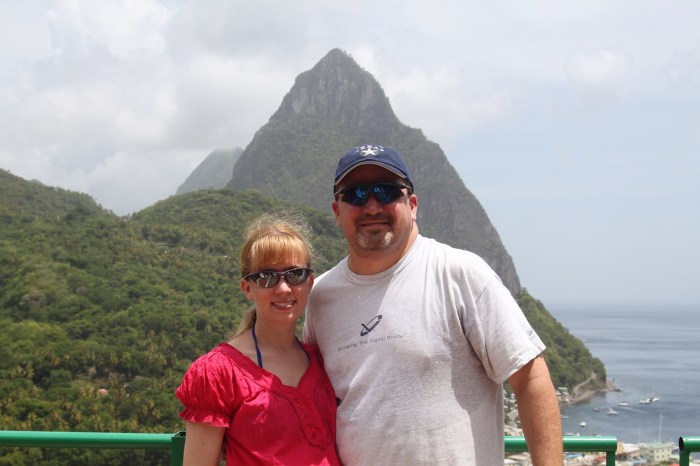
Here we are in St. Lucia from several years ago.  This was an anniversary trip that we planned and saved for for a number of months.

Heidi and JJ overlook

When I was younger and worried about how to accomplish something, my dad would frequently remind me of the saying “How do you eat an elephant?  One bite at a time.”  I doubt that elephant is on anyone’s diet plan, but you get the idea – break the big task down into smaller chunks and focus on completing that task before moving on to the next one.

Sounds simple enough, right?


You Gotta Ask Big to Get Big

The inspiration for this post came from a conversation with a friend earlier this week.  She has something she is trying to work out and said she was asking for a small portion of what she ideally wants to see as the end result.  She said she felt asking for more was selfish.  During my morning reading time that same day, I had just highlighted Mark 11:24 “Therefore I tell you, whatever you ask for in prayer, believe that you have received it, and it will be yours.” (NIV) My response back to her was asking for the full desired end result was not at all selfish and “you gotta ask big to get big.”

So easy to say and yet oftentimes so difficult to do. I know there have been several times in my life when I have not fully pursued something I wanted to see happen for any number of reasons  – feelings of fear (the most frequent culprit), unworthiness, self-doubt or pride, just to name a few that immediately come to mind.  There have also been times that I’ve been willing to “put it out there” and ask for something bigger than I thought possible and have seen them come to pass.  In high school, I set my sights on going to a top rated school for physical therapy, and I received an acceptance letter to UNC.  After grad school, I wanted to stop paying rent and instead put my money into a home.  15 months after I moved back to Texas, I purchased my first home at the age of 26.  When JJ and I were looking to buy an “our house” we wanted a home close to our church and was set up well for small group meetings.  God showed us our current house (which is a 2 minute drive to our church and has an ideal floorplan for small group meetings) while we were driving around neighborhoods one day as our old house was being shown.  When my sister was pregnant with her second child, we prayed for a healthy child to be born and our niece is now 5 years old.

Believing that you will receive what you ask for is a common challenge; let me say this – it’s a common challenge for me because I can struggle with “what if it doesn’t happen?”  James 1:6-8 says “But when you ask, you must believe and not doubt, because the one who doubts is like a wave of the sea, blown and tossed by the wind.  That person should not expect to receive anything from the Lord.  Such a person is double-minded and unstable in all they do.”  (NIV).  Sometimes I wonder how many times I have not seen something come to pass because I have second guessed myself or the process.

Over the years, I have also learned that when you’re believing for something big, it helps to tell other people.  Friends and family can help keep me on track and focused on the desired end result if my courage or faith start to waver.  Matthew 18:20 says “For where two or three gather in my name, there am I with them.” (NIV).  I find it helpful to have people pray with me and for me during times of great challenge – simply knowing that someone else cares will often relieve some of the stress I feel (whether the stress is good stress or bad stress).

So, what happens when you pray and you believe and the outcome still is not what you wanted?  Is that the million dollar question or what?  Just like I have had several great things happen in my life (the list above is not exhaustive), I have had several times where I hoped and prayed for things that didn’t come to pass as well.  Some of those experiences have been devastating – not being able to have children, having two opportunities for adoption fall through for various reasons, my sister losing two of her children, various personal relationships that didn’t turn out the way I hoped they would.  In some of these instances, I have seen how the prayer I thought was initially unanswered turned out to be answered in an entirely different way.  For instance, we are very involved in the marriage ministry in our church and are honored to pour into other people’s lives and relationships the lessons we have learned so far.  Some unanswered prayers will perhaps remain unexplained this side of heaven and for those, I don’t have a good answer as to why they are unanswered or answered differently than hoped for, other than what I read in Romans 8:28 “And we know that in all things God works for the good of those who love him, who have been called according to his purpose.”  (NIV).  Sometimes the waiting and the not knowing of how He is working things out, especially when the time stretches into months or years, can be frustrating and confusing.  The challenge then becomes to continue to move forward and ask for the next big thing in your life.

What big thing are you hoping or praying for currently?

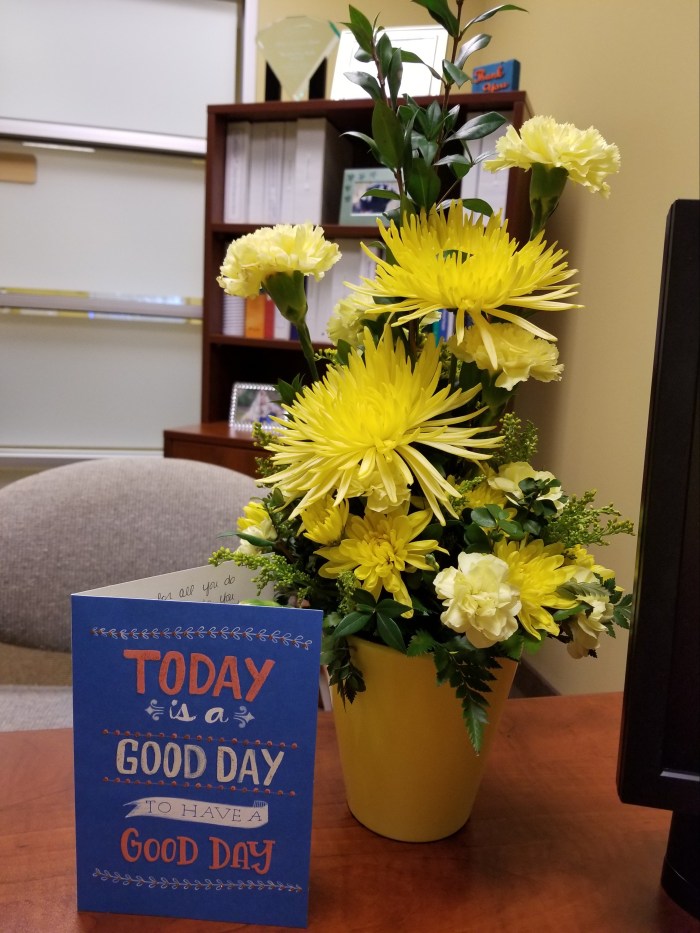
PS – I had a really tough week at work and the girls in my office surprised me with flowers on Thursday morning, so I thought I’d share them with you too.  (Thanks again, ladies!)

Desk flowers

#babymarriageproblems

Last Sunday, we taught the communication portion of the premarital class at our church, including how to navigate common challenges typically experienced during the first few years or marriage, which we refer to as “baby marriage problems.”  Doing so is as much a help and reminder to us of what is really important in marriage (and how far we’ve come in the last 14 years) as it is to the people in class.

One of the topics we talk about is the kind of issues you have when you are first married that often cause what I like to call “moments of intense fellowship” – things like the person who leaves the dishes in the sink when the dishwasher is literally a foot away, how the other person makes the bed (or doesn’t), or who leaves their shoes in the middle of the living room floor.  The last one is probably my favorite – we finally came up with the 3-pair rule.  JJ can leave two pairs of shoes in the living room and I won’t say anything, but when the third pair shows up, it’s time for them all to go back to the closet.  Honestly, at this point, I’ve learned that it’s just as easy for me to pick them up on my way to the bedroom and put them away so I don’t get to the point where his shoes bother me in the first place.  I also decided that if the bed is made or my clothes are folded and put away in my closet, the fact that those tasks are completed is more important than the fact that JJ does both differently than I do.  Different doesn’t necessarily mean worse, it just means different.

When you’re first married, it seems like every decision is a big one and the smallest issues can cause the biggest fights – the kind of fights that you look back on and can’t remember what in the world you were fighting about.  This is a natural process that all couples go through when you first combine space and now someone else is (seemingly) messing up the way you do things (do you squeeze the toothpaste from the bottom or the middle?).

When you have a conflict to resolve, or even just a challenging topic to discuss, establish a safe place in your home for these discussions.  For us, we would sit on the couch facing each other.  We have to turn off all our electronics.  JJ is prone to “ooh, shiny” or “squirrel!” if the TV is on, his computer is open or his phone is pinging.  (He admits this freely, so I’m not throwing him under the bus).  Holding hands is also very helpful.  It is difficult to not stay engaged in a conversation if someone else is holding your hands and looking you in the eye; you can’t lean back from the conversation and it is much harder to look away.

Posture, body language and tone of voice communicate as much for more than your actual words do.  Crossed arms, rolled eyes and leaning back while saying “I love you” communicate anything but love.  JJ found this State Farm commercial that is great example of how the exact same words can have two completely different meanings (https://www.youtube.com/watch?v=ultPAIkFoRw).  Words are like a hammer – they can either be used to build something or to tear it down.  Same tool, but two very different purposes and outcomes.

What you are trying to communicate may also have two very different purposes.  Let’s be real – ladies often times only want to be heard and guys primarily want to fix things.  If the rules of engagement are not established at the beginning of a conversation, chaos is likely to ensue.  Case in point: https://www.youtube.com/watch?v=-4EDhdAHrOg.  Over time, JJ has learned to ask and I’ve learned to preface conversations when all I’m doing is venting and I’m not looking for input or a solution.  If I am looking for advice, I’ll ask him for his opinion at the end of my story, and then it’s my responsibility to be open to his recommendations.  Otherwise, JJ puts on what he calls his “stone face” and adds only some well-timed “mmhmm”s while avoiding any facial expressions until I’m finished.  Once I am finished, if he has some input and I don’t ask for his advice, he will ask me if I want his recommendation.  Typically once I can get something off my chest, I’m must more likely and more able to hear his perspective than if he launches into his “fix” mid-topic.  Are we perfect at this?  Nope.  Not by a long shot.  But we have gotten better over the years with lots of practice.

Good communication does take practice and lots of it.  Communication is an acquired skill, like any other.  It takes two people both committed to the process and being willing to forgive a lot and say “That didn’t work so well.  How can we do this better next time?”  If you’re out to win every time you have a disagreement with your spouse, Mark 10:7-8 says “ ‘For this reason a man will leave his father and mother and will be unite to his wife, and the two will become one flesh.’ So they are no longer two, but one flesh” (NIV), so if you win and your spouse loses, you have also lost.

Good communication is the foundation of what the rest of your marriage is built on, no matter what area.  You will likely find over time that issues that may take you days or weeks to work through when you are first married, eventually will only take you a few minutes to work through and the number of disagreements you have decreases significantly because you’ve discovered that the issues that used to be SO big are now no longer an issue or aren’t worth arguing over.

Don’t be afraid of conflict in your marriage.  Proverbs 27:17 says “As iron sharpens iron, so one person sharpens another.” (NIV) God puts these small issues (only in retrospect do they seem small) in your path at the beginning of your marriage as a way to practice working through disagreements.  If you can learn to work through the small issues with your spouse, it builds trust that even if we don’t agree, you’re still going to be here for me and I’m still going to be here for you.  As your marriage matures (and you get older, I mean mature), you can lean into that trust as you start making bigger and bigger decisions – what kind of car are we going to buy and when? Where will we live?  How many children do we want to have?  Will those kids go to private or public school?  What are we going to do about Dad now that his health is failing?  Making the bigger life decision without the practice of the smaller decisions can be much more challenging.

If you’re newly married, experience as many of the #babymarriageproblems as you can in the beginning.  They will serve as touch points to look back on and laugh as well as help build a strong foundation for the rest of your marriage.

Here’s my last piece of advice for today to make your household a happier place – dual sinks and closets in the bathroom.  Just sayin’….

IMG_1690


Thank You For Your Service

JJ and I went to a training on Friday night and Saturday presented by Paul L. Henderson, J.D., LTC (ret.) US Army, on how to help vets with post traumatic stress (PTS) adjust to civilian life once they leave the military.  Even though JJ is not a combat vet and does not have PTS (for which I am eternally grateful), I still learned a great deal about him related to his military service over the course of the weekend.  The timing of this class was rather ideal as JJ’s retirement date is now just a few months away.

One of the things that struck me during the class were the number of words used that started with “de.”  Deployment, detachment, demolition, DMZ (demilitarized zone), defined.  The prefix “de” is defined by Dictionary.com as “used to indicate privation, removal, and separation, negation, descent, reversal, intensity.”  With military service, there is an inherent level of separation (from your family, civilian life, creature comforts, among other things) upon joining.  Depending on which branch and what kind of job you are trained for, there can also be separation from a prior moral compass and sometimes even from yourself in order to get the job done.

As a civilian, who lives in the United States, while society today certainly has a much greater respect and appreciation for our military, it is still very easy to feel detached from those that serve since (for the most part), the war of the past 17 years has been fought on foreign soil.  In high school, I can remember watching bombs exploding on a green screen on the TV news feeds of Desert Storm in the 1990s and not knowing how to process what was going on half a world away.

Almost thirty years later, I feel only slightly more connected to the military, even being married to someone who serves.  I filled out a survey a few months ago, part of which asked about my experience with military service.  Despite the fact that JJ has been in the military for 11 of our 14 years of marriage, I have not considered myself a true “military spouse.”  Yes, I have gotten used to him being gone one weekend a month and two weeks a year, but I have never felt like he was going somewhere that was dangerous or that he might not come home and I have not had the experience of having my spouse be gone for six, twelve, even eighteen months at a time, with the possibility of not knowing exactly where he was stationed.  My hat is off to service members who deploy and to their spouses who learn to live with those conditions for a few years of an initial commitment and especially to those who do so for the length of a full 20+ year career.

When a vet comes home (after whatever length of service), the “de” words turn into “re” words; reenter, reestablish, reintegrate, retire.  The prefix “re” according to Merriam-Webster means “1 : again : anew. 2 : back : backward.”  If the vet went straight into the service out of high school (either enlisted or to one of the Academies), they don’t have much frame of reference of a life to go back to.  All they have known as an adult is the military – they are defined (back to a “de” word) by who they became while they were in – their sense of purpose and belonging, their community, is tied up in this group of people who are separated from society.  Their vocabulary is different, their customs are different, they are bonded to the people in their unit (another word that very sterile, separate) in ways that cannot be duplicated with even the best of their civilian friends or frequently even family members.  Many times a vet will “re-up” to return to an environment that makes sense to them, an environment that may hold some of their worst, as well as their best memories.

JJ returned to the military with an enlistment in the Reserves seven years after leaving active duty.  Our decision to do so was primarily for the retirement benefits in the future, but he talks fondly about parts of his experiences in active duty that he was unable to duplicate elsewhere during those seven years.  He has told me that he had a greater challenge transitioning to civilian life after active duty in 2000 than he anticipates doing so when he retires in August.  I’m not naïve enough to think that there won’t be some period of adjustment for us both; he says he will miss the people and the comradery the most.  For me, I think it will be strange having him around every weekend.  I’ll likely adjust more quickly than will he.

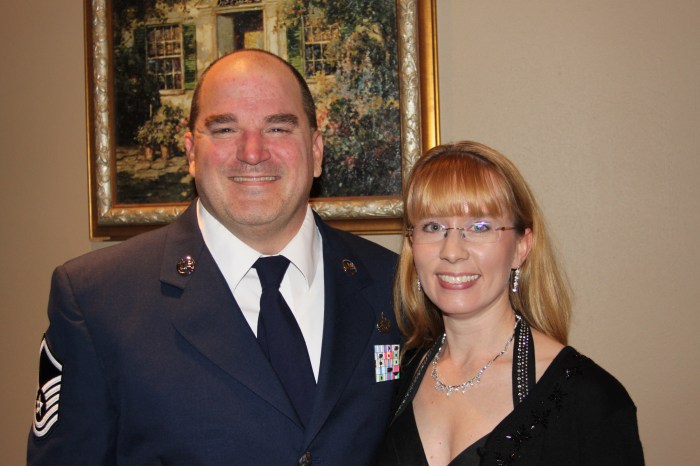
This photo is a few years old and is the most recent one I have of the two of us with him in uniform.   He does look great in his dress blues!

IMG_1119

For more information on the program for returning vets, go to www.soldiersheart.net or contact Lt. Colonel Henderson.  His bio and contact information are below.

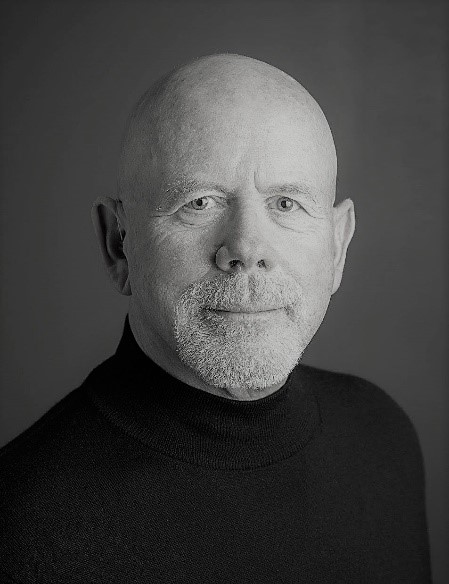
Lt Colonel Henderson

Paul L. Henderson, J.D., LTC (ret.) US Army, is a combat veteran who served in Vietnam with the 101st Airborne Division during 1969 – 1970. He was later commissioned and graduated from the Special Forces Qualification Course. He served a total of 23 years in the Army, retiring in 1996 as a lieutenant colonel.  In 2009 he attended a Soldier’s Heart workshop in Colorado and became convinced that the approach of Soldier’s Heart, pioneered by Dr. Edward Tick, was the most effective method for dealing with the psychic wounds that often follow service in combat. He eventually became a workshop facilitator for Soldier’s Heart. Paul also conducts workshops and lectures across the US on the subject of PTSD and warrior healing. He has worked with both veterans and active duty military personnel and has appeared on radio and television.

He can be reached at:  Phender745@gmail.com, (360) 901-3748

Enlarge The Place Of Your Tent

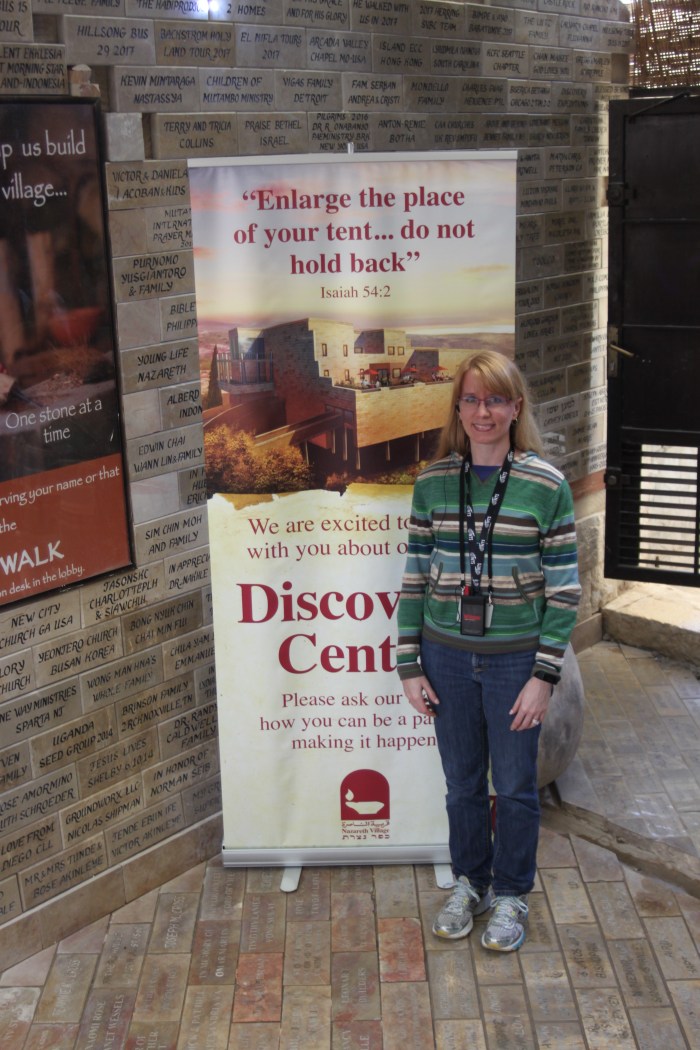
As we were walking out of the Nazareth Village, the verse on this sign caught my eye and stirred something in me.  I originally asked JJ to take a picture of just the sign and JJ was smart enough (as usual) to have me go stand in front of it while he took a second picture.

IMG_1719

Perhaps you are like me and the thought of expansion is sometimes (okay, full transparency here, frequently) daunting.  I like routine and predictability and enlargement/expansion delves out into the realm of the unknown.  And yet, after a period of time, I also become restless if I feel like I am not growing or learning something new, which forces me to confront the decision of whether or not I want to make changes and step out into something new or learn to be satisfied with the status quo.

I won’t lie – there have been times in my life where I was happy to stay at status quo.  I didn’t want to put in the time, effort, emotion, money, whatever to take the next step forward.  There have been times that I have stepped forward through what I felt was the correct open door in front of me and an amazing opportunity was awaiting my arrival.  And there have been times that I have stepped forward into something that has not worked out the way I thought it would and I had to step back, reevaluate and regroup to see if I needed some course correction to continue down the same path or if I needed to take a new path altogether.  Some of those mis-steps have turned out well with some tweaking and some have not turned out well at all and been quite costly.  What I have learned is that every experience (good and bad), every learned lesson (especially the hard ones) add to the sum of who we are and both prepares us for what continues to lie ahead in life and be more patient with other people when they encounter similar circumstances.

I have read several personal development and “self-help” books over the years.  Most of them seem to boil down to the same general set of recommendations: decide what it is that you want to accomplish, visualize yourself succeeding at the goal you set, put a team in place around you to help you succeed and keep going/maintain your focus until you accomplish your goal.  Easy to say, harder to implement.  For me, I think it all boils down to choosing to put one foot in front of the other every day to walk towards whatever your goal is (getting out of debt, losing weight, improving your marriage, furthering your education, etc).  There will be days that you make tremendous strides forward.  There will be days you fall down.  There will be days you choose not to walk at all.  The important thing is make a new start the next day and take the next step.  Lamentations 3:22-23 states “Because of the LORD’s great love we are not consumed, for his compassions never fail. They are new every morning; great is your faithfulness.” (NIV)  And then there is the old Chinese saying by Lao Tzu “The journey of a thousand miles begins with a single step.”  In the same vein, the journey of a thousand miles also ends with a final step, which may become your first step on the next journey.

For me, this blog is my current step of faith in enlarging the place of my tent.  My current goal is to have a weekly post on Sundays and to develop a consistent international readership.  My hope is that the words God gives me to share my experiences help someone who may be going through something I have already walked through, even if it is just to let them know that they are not alone and that someone else has made it through something similar.  If something you have read has spoken to you, would you please do me a favor and click the “follow” button on my blog and/or share a post that is meaningful to you?

What are you currently hoping to enlarge in your life?  How can I assist you with your goal?

Walking In His Steps

Happy Easter!  I have a new appreciation for Good Friday through Easter Sunday and the steps that Jesus literally took from Friday leading up to today.  After standing in the Garden of Gethsemane and trying to imagine what that night must have been like for Jesus (and his disciples), we went to the house of Caiaphas, where we saw the steps that Jesus walked up when he was taken to Caiaphas for questioning and then back down when he was taken to Pontius Pilot.

IMG_2150

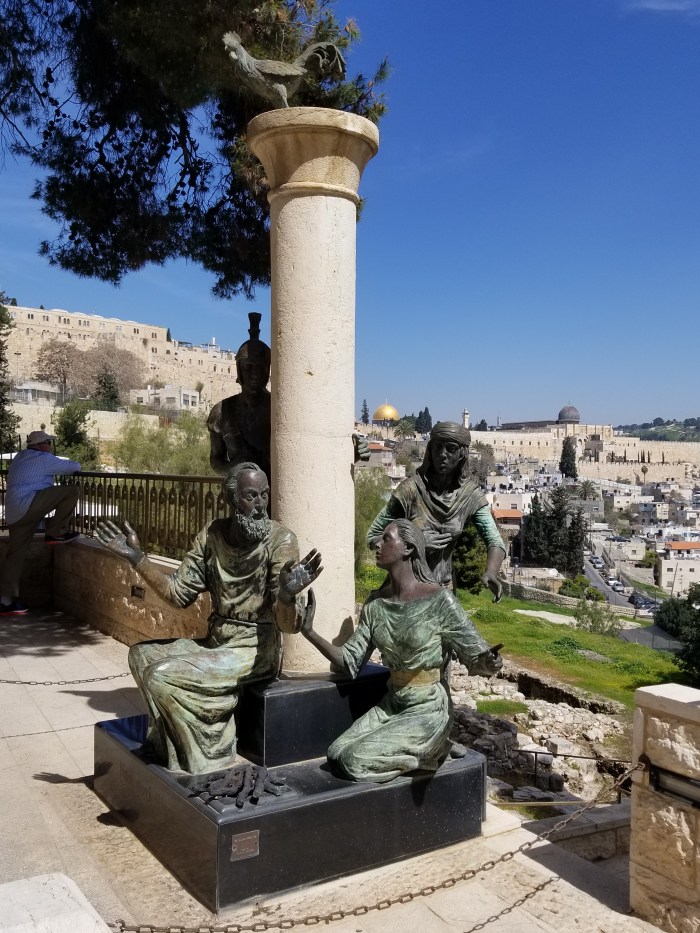
The courtyard of Caiaphas’ house is also where Peter denied Jesus three times as He was led away.  Pastor Amie taught us that Peter’s denial of Christ was not that he denied actually knowing who He was, but that Jesus had not turned out to be the conquering hero that Peter had anticipated. Below is a statue of Peter denying Jesus to a girl and a Roman solider in the background.  I was surprised at the proximity of Caiaphas’ house to the temple, as you can see the Temple Mount from the courtyard.

20180313_111521

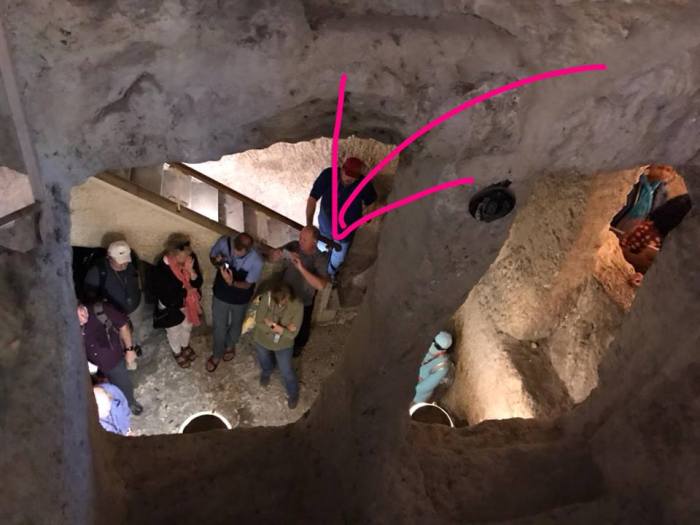
Caiaphas’ house is now The Church of Saint Peter in Gallicantu (complete with a rooster on the roof). In the basement is the cell where Jesus was held for three hours before he was taken to Pilot.  There are now steps that lead down into the cell and lights on the wall, but at the time, the cell was literally a hole carved into the ground and prisoners were lowered into and pulled out of the cell by a harness.  Seeing the reality was much different than my mental picture of Him being kept in a more traditional holding cell. I now have a visual reference for the verses in the Bible (like Psalm 88:4) that mention “going down into the pit.” (This photo was taken by one of our friends on the trip, April Pointer).

Sacred pit 2

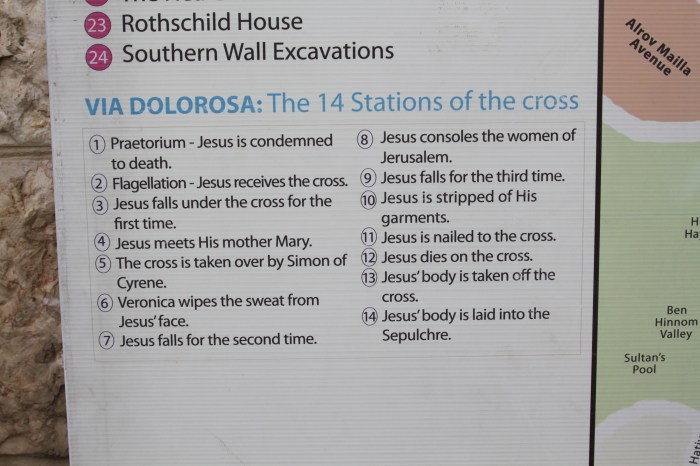
We walked along the Via Dolorosa, which demarcates the various places Jesus stopped on his way to the cross after he was taken from Caiaphas’ house.  We walked from the end to the beginning, which is kind of like watching a VHS tape in rewind (if you’re old enough to remember VHS).  None of the stops along the way are far apart (some only a couple hundred feet), but the walk for Jesus was all uphill, after a beating, carrying a heavy cross.

IMG_2334

IMG_2344

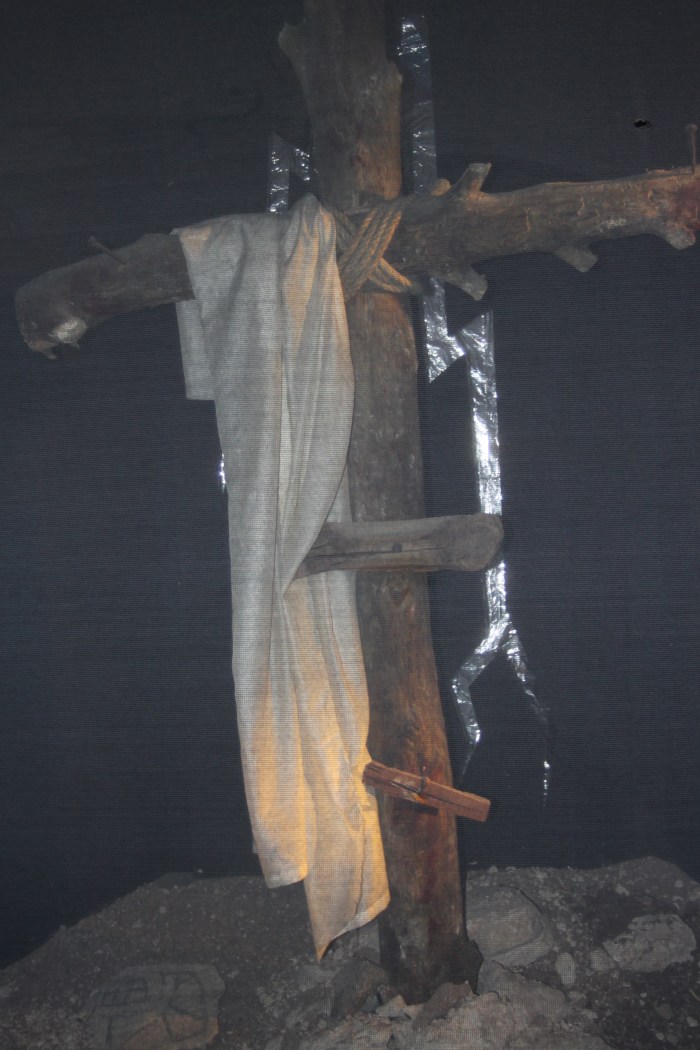
We saw a replica of a cross when we stopped previously at the Nazareth Village.  The cross was gnarled and uneven – not the even, squared off cross you typically see in Easter movies or pageants.  I became aware of an added level of discomfort that Jesus must have had that I had not previously considered.  My photo of the cross did not come out very well since it was behind glass, but well enough that you may get the gist of what we saw.

IMG_1663

Caroline, our guide, mentioned something that I have heard over and over, but for some reason it struck me new that day.  She reminded our group that Christ gave up his life at the cross.  In all my years, I have known that Christ went to the cross willingly, but I have mis-read the sequence of events, thinking that Jesus died and then his Spirit returned to the Father.  The day I stood in front of that cross, I realized that Jesus returned his spirit back to the Father by choice as He had completed the work for which He had come to Earth.  Only after that conscious choice, did his flesh succumb to death, not the other way around.  That was a huge paradigm shift for me.

Golgotha and the Garden Tomb were both much different than I had pictured in my mind’s eye.  I wasn’t quite sure why the hill was named “the place of the skull” but it is because there is what looks like a skull in the rocks on the side of the hill.  The nose used to be more pronounced, but the tip has fallen off over the years.

GolgathaEyesAndNose

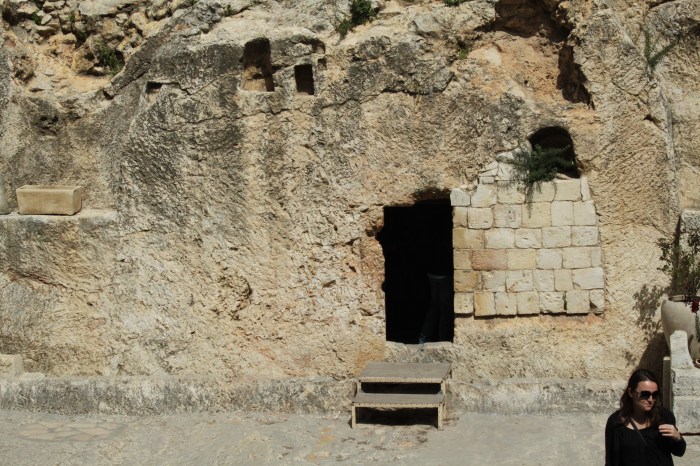
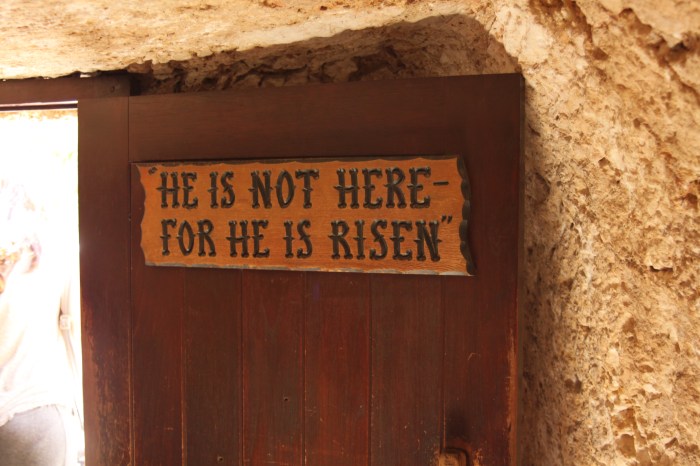
The Garden Tomb for me was the most impactful place of our whole trip.  I had expected the tomb to be much larger and laid out differently.  The door was very small, which explains why Mary had to bend down to see into the tomb (John 20:11, NIV).  The original door has been enlarged to make it easier for visitors to get in and out.  Even with the enlargement, I had to duck, (which is saying something since I am only 5’1).

IMG_2324

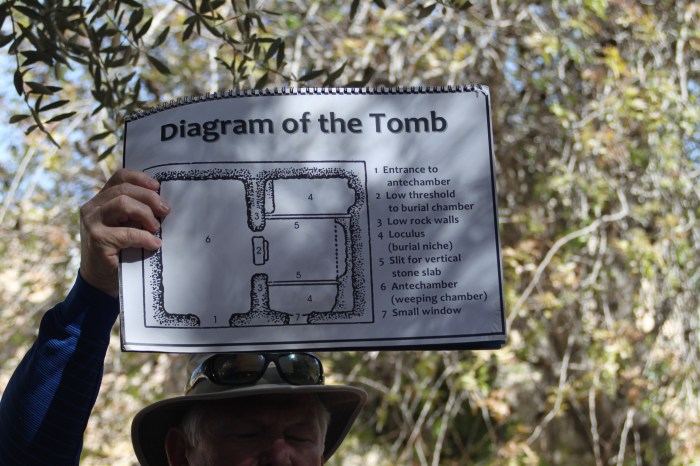
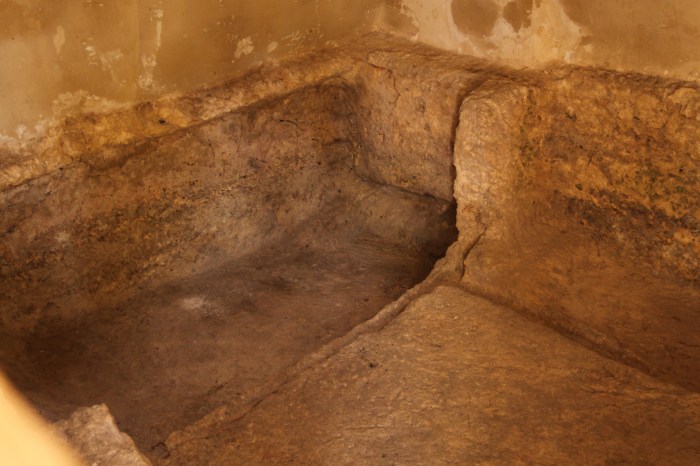
In front of the tomb a track was carved out where the stone was rolled back and forth.  You step through the door into a visiting chamber and the bodies of the deceased were laid in niches on the right, each carved at a slight decline.

BoydGuide

Jesus was not a tall man, as I’m not sure that JJ would have fit in the place where Jesus was laid (JJ is 5’10).  There is a low wall where the angel would have been sitting when he spoke to Mary (Mark 16:5, NIV).

IMG_2313

The tomb is still empty.  I’ve seen it with my own eyes. (Matthew 28:6, NKJV)  Hosanna in the highest!

IMG_2319


Palm Sunday

Happy Palm Sunday!  We came home last weekend after spending a week in Israel.  JJ and I had been talking about taking this trip for several years and are blessed that we were able to go this year.  Several of my friends have been asking for pictures, so since I am finally recovering from jetlag over the last day or so (I didn’t think it would take me a full week to readjust to the 8 hour time difference), today is a great day to begin sharing some of my pictures and experiences.  The timing of our trip is ideal since we literally were walking the Palm Sunday road a little over a week ago, which gives me an entirely new perspective on remembering the Passion Week this year.

IMG_1966

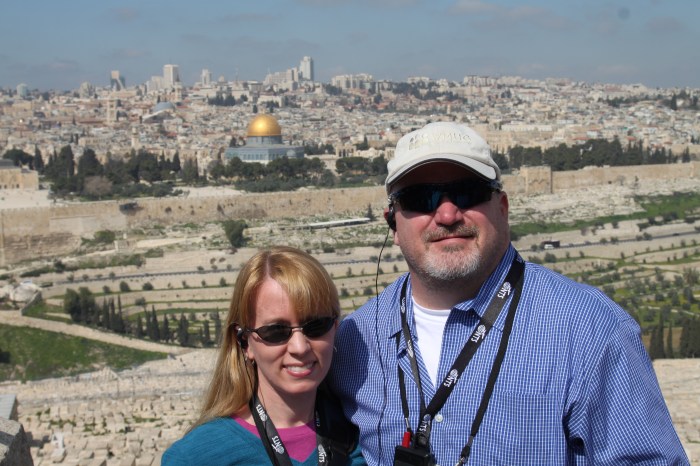
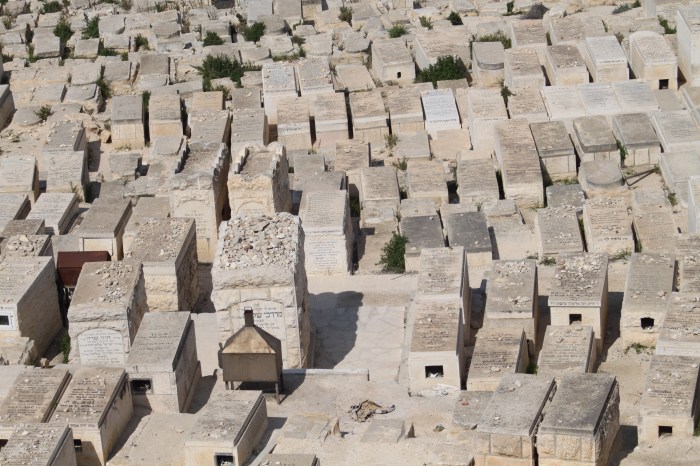
Here we are at the top of the Mount of Olives, which is covered with graves of people who want to be first in line when Jesus comes back.  When the graves are visited, the visitors leave stones instead of flowers since stones do not wither and die, but leave a constant reminder of the visit.  Some of the graves have piles of stones on them and some only a few.  Someone asked our guide, Erez, (who was AMAZING – an Israeli born Messianic Jew who has been giving tours for the past 23 years.  He was a wealth of knowledge of history, scripture, and architecture) what is required to be buried on the Mount of Olives today and his tongue-in-cheek answer was “money.”  The grave of the prophet Samuel is there, which was present before the time of Jesus, which just amazes me.

GravesOnHillsideWithRocks

The Palm Sunday road starts at the top of the Mount of Olives.  The road is now paved, but I can imagine what it would have been like as a dirt road.  The road is very steep and windy and must have been a slow ride for Jesus on the donkey, due to the angle as well as the crowd of people that would have been on each side.  As I walked down the hill, I wondered what kind of thoughts Jesus had as he entered the city – I’m guessing a combination of sadness, anticipation and I’m tempted to even add some joy regarding the fulfillment of his purpose to eliminate the division between God and man.  Pastor Stephen reminded us this morning that when a king entered a city that he intended to conquer, he rode in on a stallion, but when he entered his own city or a city that was ruled by a friend or ally, the king would ride in a donkey to signify that he came in peace.

The Garden of Gethsemane is at the bottom of the hill, a highway now runs through the middle of the Kidron Valley, and the Beautiful Gate into the old city is at the top of the Kidron Valley opposite the Mount of Olives.  I had previously imagined that the Kidron Valley would be a much larger, deeper valley, but everything is very compact in Israel.

2000YearOldOliveTree

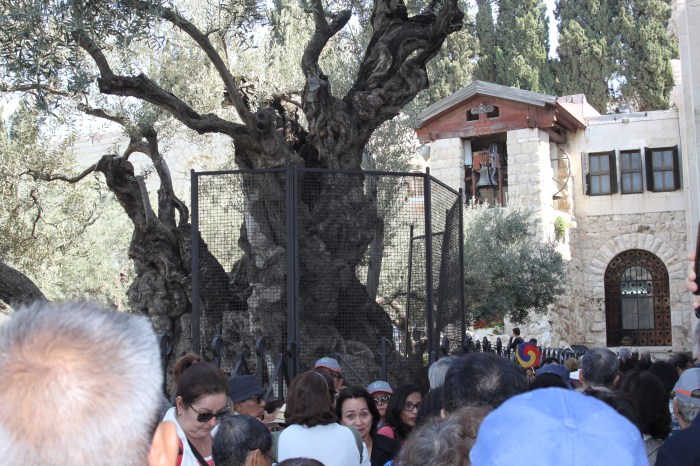
Standing in the Garden of Gethsemane was a solemn experience for me to think about the mental anguish that Jesus went through as he prayed 3 times to ask if there was some way out of what he knew what was coming, yet yielding to the Father’s will each time.  The tree above is estimated to be 2000 years old and may very well have been present during Jesus’ time.

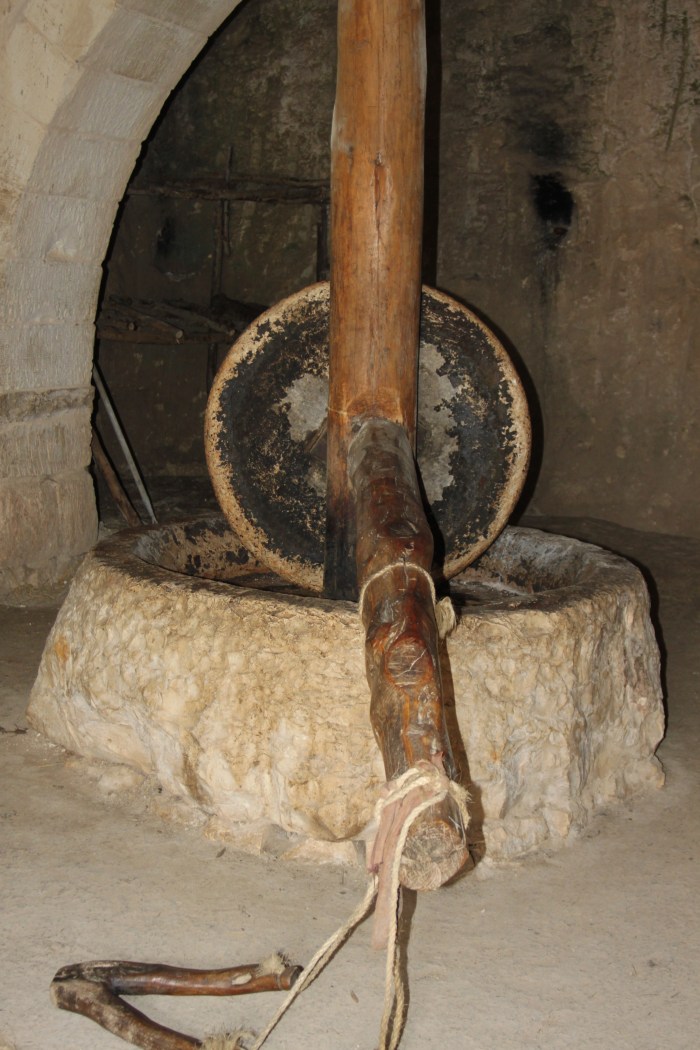
The day that we went to visit the Nazareth Village, our tour guide for the day, Caroline (I ran into UNC reminders three different times during our trip), showed us an olive press and told us about the process involved to extract olive oil.  The olives are first crushed by a millstone (which was much larger and heavier than I would have expected – now I understand why throwing a millstone over the wall of a city could kill several people at once) into a paste, which is then transferred into mesh baskets.

IMG_1701

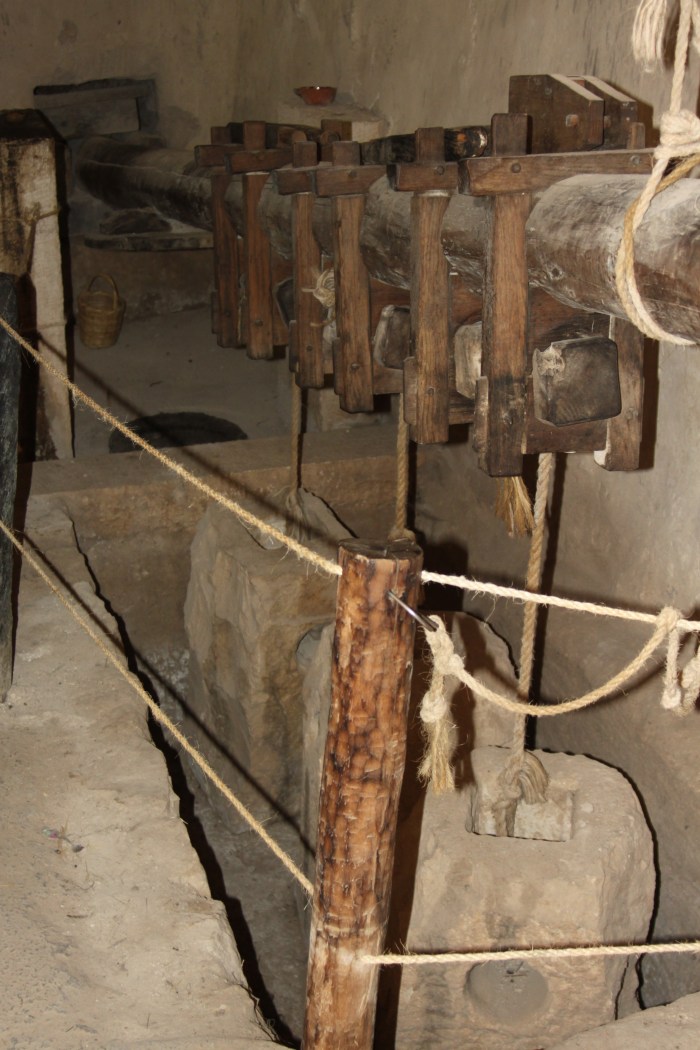
The first pressing (producing extra virgin olive oil) was collected with only the pressure of the olives in the baskets.  This oil, the first fruits, was sent to the temple for anointing and prayer.  The second pressing (producing virgin olive oil), was collected with half of the weight of the olive press applied to the baskets.  This oil was used for cooking and healing.  The third pressing (producing olive oil), was collected after the full weight of the olive press was applied and this oil was used to light their lamps.

IMG_1698

Caroline told us something very interesting after that – I thought that the residuals would simply be discarded, but she said that what was left over was used to start fires.  I find it interesting that after Jesus prayed/was pressed 3 times and eventually gave his life, that the Holy Spirit came (as Jesus told the disciples that it was good for them for Him to go, as the comforter would come after his departure) as tongues of fire.  I’m certainly not saying that the Holy Spirit is a left over, but there is purpose in everything Jesus did from start to finish.

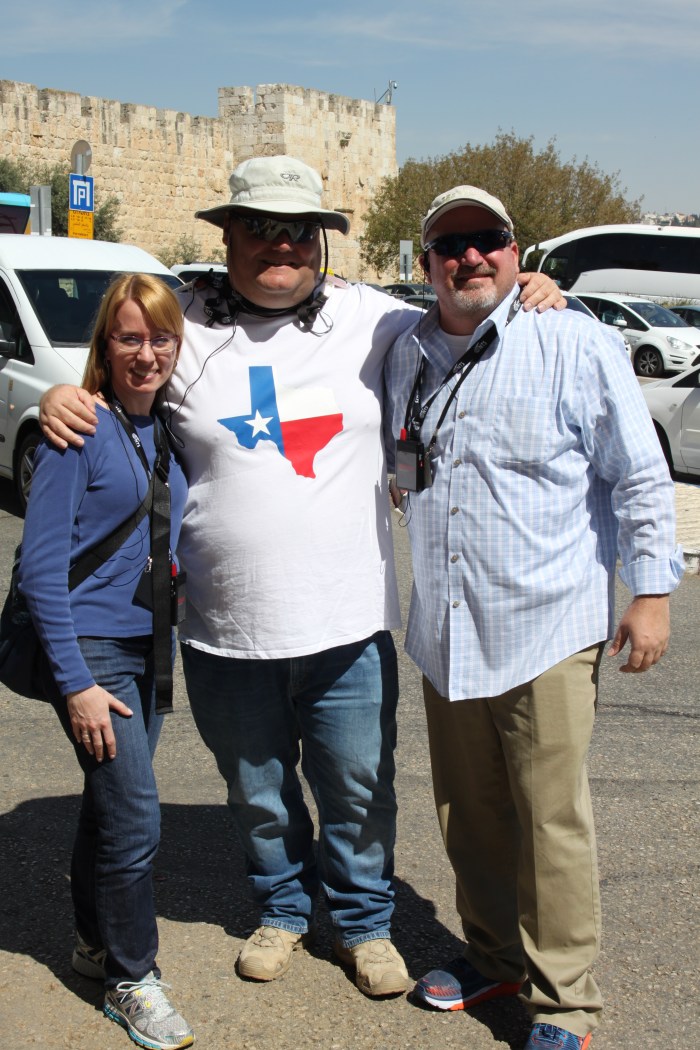
More pictures and memories to come.  Here is a picture of Erez, our tour guide.  If you go to Israel (highly recommended!), look him up.  Most of our group was from Texas, so I had to get a picture on the day he wore his Texas shirt.  🙂

Erez

Choosing the Right Words

During the sermon in church today, Pastor Stephen spoke on James 3: 1-5 and taming your tongue; knowing when to speak and when to hold your tongue.  Admittedly, this is a lesson I am still learning.  I’ve heard this passage many times and it pings me every time, especially the part about “Anyone who is never at fault in what they say is perfect, able to keep their whole body in check.”  Wouldn’t that be amazing to keep your whole body in check?  Definitely something to continue working on.

The point that jumped out at me today was when Pastor Stephen made the comment that all the muscles in your body come in pairs, except your heart and your tongue, which are the pair for each other.  Having taken many courses in Anatomy and Physiology over the years, the science nerd in me wanted to come home and look up the innervation of (the nerve that supplies) both muscles, just to see if there was by some chance a common nerve between the two.  What I found was fascinating.

I started to think about verses that I knew contained words about the heart and the tongue.  These are the 3 that specifically came to mind:

Matthew 12:34: “For out of the abundance of the heart the mouth speaks.” (NRS)

Proverbs 16:24: “Kind words are like honey— sweet to the soul and healthy for the body.” (NLT)

Psalm 34:8: “Taste and see that the Lord is good.”  (NIV)

This is where it got really exciting for me.  I pulled out my anatomy book and looked up what nerve innervates the heart and the tongue.  It turns out that part of the Vagus nerve (Cranial nerve 10 – the number ten becomes important in a minute), supplies part of both the tongue and the heart, as well as part of the lungs, stomach and intestinal tract.

The part of the tongue that Cranial nerve 10 innervates is responsible for (you guessed it!) taste, as well as the laryngeal muscles (for phonation or sound creation).  In your heart, the Vagus nerve is responsible for your heart rate.  In your lungs, the Vagus nerve regulates your breathing and in your stomach, the Vagus nerve helps with regulation of the digestive process.

So biologically, for the verse in Matthew, the heart and the tongue ARE connected – the same nerve that helps control your heart, is also responsible for sound production for your tongue and helps provide the breath behind the words so that they can be heard.  In the same vein (I know we’re talking about nerves here and not veins), this connection would also explain why when you know something in your heart, many times you also feel it in your gut.

I have previously felt like the Proverbs verse was just poetic. Looking at this same verse in a new light, honey tastes good in your mouth, then goes down into your stomach and the nutrients are absorbed by your intestines.  And whose heart isn’t happy when you have something that tastes good in your mouth?  (I think you could just as easily insert “chocolate” for “honey” but that’s just my opinion – maybe it would need to be dark chocolate in order to get some health benefits).

As for the verse in Psalms, understanding how to “taste” God’s goodness has been a challenge for me – don’t get me wrong, I appreciate a good meal as much as the next person, but I don’t think the verse only pertains to a culinary experience.  After my study tonight, I think it means more that you know God is good in your heart and your mind and your gut, all of which are connected with the same cranial nerve.  (I wish I had put all this together when I was taking exams in Anatomy all those years ago – I probably would have received much better grades on my tests!).

What about the fact that this particular cranial nerve is number 10?  Is there something specific about the number 10 that might also be relevant to this one crazy nerve that goes to so many different and seemingly unrelated parts of your body?  A quick, and not nearly exhaustive, internet search led me to a page which states: “Ten is also viewed as a complete and perfect number, as is 3, 7 and 12. It is made up of 4, the number of the physical creation, and 6, the number of man. As such, it signifies testimony, law, responsibility and the completeness of order.” (http://www.biblestudy.org/bibleref/meaning-of-numbers-in-bible/10.html).  So this perfect and complete nerve is what we engage for what goes into and comes out of our mouths.  What an awesome responsibility for one nerve and what a responsibility we have to use well all the functions that this nerve provides.

I was amazed by all these connections tonight.  I hope you were too.  Thanks for listening (that’s Cranial Nerve 8).

The Big Dog Park in the Sky

We dropped off our sweet girl, Jett, at the eternal dog park on Thursday.  She would have been 13 in March and she joined our family when she was 10 weeks old.  She gave large, slobbery kisses, made sure we left the house with her hair on us somewhere, was always happy to see us come home, and occasionally snored in symphony with JJ.  She loved to ride in the car and was well traveled – she went with us to Colorado and Arizona, including a walk along the edge of Grand Canyon.  She hated the kennel and was good friends with our house sitter.  Our house feels very empty and I find myself still looking for her when someone rings the doorbell or it’s time to go to bed.  She was our “child” and we’ll miss her dearly.

Death is ______________ (fill in the blank):  confusing, saddening, maddening, inexplicable, traumatic, sometimes predictable, sometimes unpredictable, inevitable, a relief, peaceful, closure, completion, a celebration.  Death can be any combination of these emotions, depending on the circumstance.

I have been to seven funerals/memorials in my life. My first encounter was in 7th grade – one of my classmates had a brother who was hit by a car while on his bicycle.  I went to the funeral with a friend and her mother.  My friend cried quietly through most of the service and looked over at me once with a look of puzzlement since I didn’t cry that day.  I think at 13 I wasn’t quite sure how to process the whole experience, but I remember feeling badly for my classmate, who was a macho kind of guy – he suddenly looked so much smaller and I had never seen him cry before.

The rest of the services I have attended have all been in the last 10 years (my grandfather, a family friend who lived with us for a short time while I was in high school, my dad’s business partner and her husband (at different times), and two of my sister’s children.  Each time I have had a different response.  My grandfather’s service was a celebration.  He lived to be 96 years old and died of old age.  He was in the Army during WWII, was married to my grandmother a few months shy of 66 years, was a doctor, flew a Cessna and had 3 children and 7 grandchildren who all loved him.  There were no tears that day either.  His memorial was a reminder of a life well lived.

The three family friends were more somber as they were all disease process related – cancer or the like.  They were all in their 70s or 80s, which no longer seems as old as it once did.  Their services felt more like I was there to be support for the surviving family members (does it strike anyone else as odd that the words “survived by” are typically used in an obituary?  I think I would rather have my obituary read something like “leaves a legacy of” or “was loved by”).

My sister’s children were a much different experience.  I felt a profound sense of loss and grief, both for the pain that my sister and her husband and daughter went through and for the two precious lives that never had the chance to begin.  Many tears were shed over many days.  My nephew and niece’s birthdays are today and tomorrow, so we remember them especially this time of the year.

For our sweet girl, her ceremony was a few quiet moments in the vet’s office with just the two of us.  Thursday afternoon was the first time I witnessed the loss of life in person.  She very peacefully went to sleep and I am comforted that she is not in pain anymore.  Leaving her on the table in the vet’s office was ranks up there with one of the hardest things I’ve had to do.

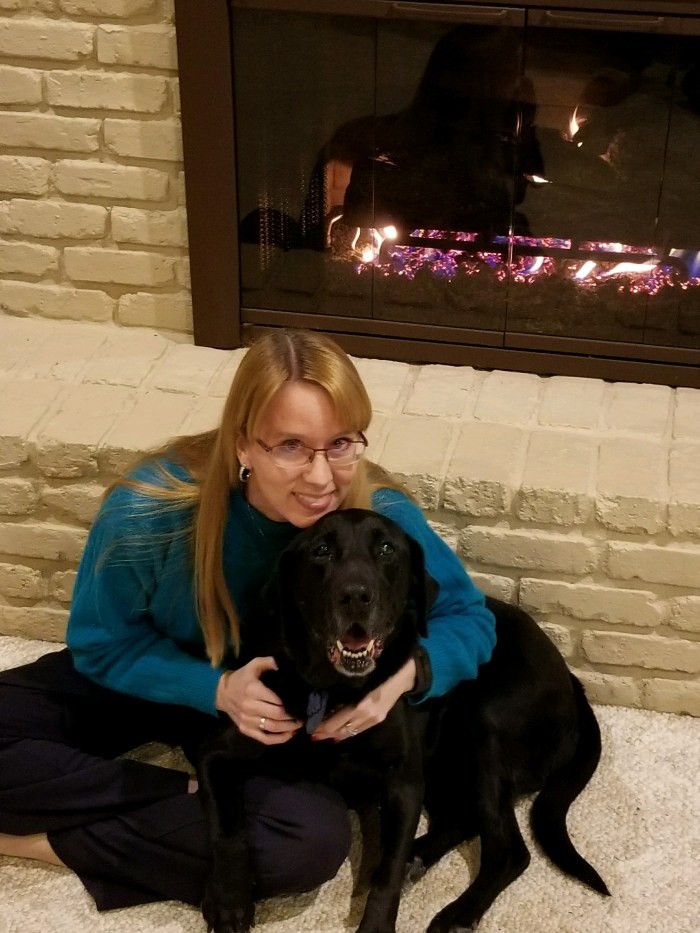
My dad came over Wednesday evening to say goodbye and took some pictures for us.  Here is one of my favorites from that night.  We love you, Jett.

Heidi and Jett 011818